Sunday, October 25, 2015
Shanken pg 228-247
On page 245, Shanken discusses artists Steve Mann and it's a bit disturbing what he says,"Military computer vision systems are now turned back toward us where the hidden cameras in the public baths transform our world from Baywatch to Bathwatch. Hidden underwater cameras in municipal swimming baths (246)." I'm not sure on how accurate or widespread something like this is, but just thinking about it makes me think that anyone could be watching me. Just kidding, I'm not that paranoid. I'm glad I'm not that famous for someone to even want to spy on me and I wouldn't want that either. But this brings into question our privacy. How private are our lives in reality? Just because someone isn't recording you with a camera doesn't mean that they can't monitor you somehow. For example, anyone who has Internet can be monitored by the Internet Provider which does keep track of every website visited and what a person downloads. Most people are oblivious to the fact that they are in a sense being watched, but not directly but indirectly. It's not like the ISP is going to fine you for downloading illegal content which they could do by advising proper authorities. Either way, they're probably more concerned about how much bandwidth a person uses or as long as they pay their Internet bills on time.

Shanken pg 213-228
On page 217, Shanken discusses robotic architects like Nicholas Negroponte and what Negroponte says is interesting when he discusses machines, "However, it would appear foolish to suppose that, when machines know how to design, there will be no missing information or that a single designer can give the machine all that it needs. Consequently, we, at the Architecture Machine Group at M.I.T., are embarking on the construction of a machine that can work with missing information." It amazes me that people are working on something like this. This reminds me of a really advanced artificial intelligence machine that could possibly think on it own. I feel like there have been countless movies about something like this happening in films like Terminator and Marvels Avengers Age of Ultron. The kind of technology would hint that robots would be uncontrollable and disobey there commands. But those movies are works of fiction. This kind of technology seems like it could be used effectively to go to far away distances, but still, they would need a constant energy source to keep them running.
Wednesday, October 14, 2015
Shanken pg 202-213
On page 209, Shanken discuss artist Geoffrey Batchen and he says something that I would agree with when he says "In short, the absence of truth is an inescapable fact of photographic life." I think that most people would assume that they have the truth when they look at photographs from an article online or newspaper in front of them. Which one adequately portrays the truth of the photographs involved? Back then, before the digital age, most people though that the newspaper photographs in their hand was actually telling them the truth. And in the digital age, most people think that the photographs in the article online sometimes is trustworthy but not all the time. Why is there a trust in the newspaper over the online article? I would argue that both don't adequately ever told the truth. In some way, all images are manipulated whenever a newspaper or magazine is involved. That brings us to the concept known as "The Myth of Photographic Truth." Photographs or images that are taken, are then edited specifically to portray a "truth" and while ignoring other aspects that could have been photographed is a way of falsely trying to represent the truth. People nowadays wonder if photographs ever tell the viewer the truth because somehow they usually are tampered with i.e cropping, touch ups, etc.
Tuesday, October 13, 2015
Shanken pg 193-202
On page 198, Shanken introduces another artist who I have researched who's name is Nam June Paik. Shanken refers to something that I heard before in one of the fine arts courses I have taken with Doug when he says that "Marshal Mcluhan's famous phrase 'Media is the message' was formulated by Norbert Wiener in 1948 as 'The signal, where the message is sent, plays equally important role as the signal, where message is not sent' (198). This to me means that let says I made a video for an art class, the video's content is one thing, while the media being the video also sends a message that it's digital. At least that's what I remember it meaning. On page 194, Shanken discusses Lucio Fontana and he says something that I would say is a pretty bold statement, "We live in the mechanical age. Painted canvas and upright plaster no longer have a reason to exist." I would agree that we live in a mechanical age, but I would not agree with what he said about a painting canvas be obsolete. Artists like Bob Ross have been phenomenal at creating great paintings and I still see it as a vibrant and still living medium. The statement from Fontana really discredits the art making medium of painting, which I thinks can sometimes be more beautiful than something done mechanically.

Bob Ross
Shanken pg 182-193
On page 182, I think what Shanken says is pretty accurate when he says that "scientists increasingly have come to realize the value of artists not just as producers of attractive visualizations of data but as creative partners, whose insights and methods can fundamentally alter and expand their intellectual vision, spurring innovation and invention in the laboratory." I see artists, and this can come from practically any medium, as innovators because being recognized by scientists is a big step for the art making community to inspire artists to continue doing what they are doing, which is making art. This is something that I also interests me as an artist because as I view my classmates work, this makes me think that someday one of us DTC students will invent something innovative for the art world. On page 186, Shanken mentions artists who I have researched who's names are Steina and Woody Vasulka and there innovative institution called The Kitchen. Shanken describes it as ". . . the first American institutions to embrace the emergent fields of video and performance art, while also presenting new visionary work within the fields of dance, music, literature, and film (186). This institution helped launch the careers of artists and I think something like this is something that would greatly benefit all artists trying to make an name for themselves.

Sunday, October 4, 2015
Shanken pg 166-182
On page 166, Shanken discusses simulations and that "since the early 1970s, artists have further employed a variety of technologies and techniques to engage audience in increasingly interactive and immersive exchanges with simulated forms and environments." Simulations have so many different uses that it has been a frequently used medium by artists. Simulations are not just for artists, but have even by used by military and even for test flights for airplanes and such. One great example of simulations responding to a persons interaction is seen in a piece by Myron Krueger called Video Place. This is a way for the person to interact with a digital environment by using their own body to send signals from the camera to the computer and display it on video. This is something that video game console systems like the Xbox Kinect already utilize. Instead of a person using a controller to interact with the digital environment, a person can use their own body with the camera's recognition software so that the can play games with no strings attached. Artist like Krueger, probably inspired things like the Kinect, which is a good reason why artists should experimenting,even if people thing that what they are doing is weird or not even art.

Saturday, October 3, 2015
Shanken pg 140-166
On page 140, Shanken discuses that "Artists have joined their bodies, and their audiences, with electronic media or or created robots and other forms of surrogate beings in order to examine the cyborgian nature of human existence and to ponder what a post-human existence might be." This concept is intriguing because no one really knows what a future after humans would look like. I start to think of a film called I, Robot, and imagine it would look something like that but maybe not as chaotic. But at the moment, robots require someone to program them, they cannot function on their own without someone assisting in the maintenance of them. One piece in particular that has great potential is the piece called The Senster by Edward Ihnatowicz, which had many capabilities including being able to respond to stimuli via a microphone and computer. To me this feels like artists are trying create these robots to be somewhat alive, but once the artificial intelligence is implemented, that would be something awesome to see with all the other capabilities of these kinds of robots.

Friday, October 2, 2015
Shanken pg 120-140
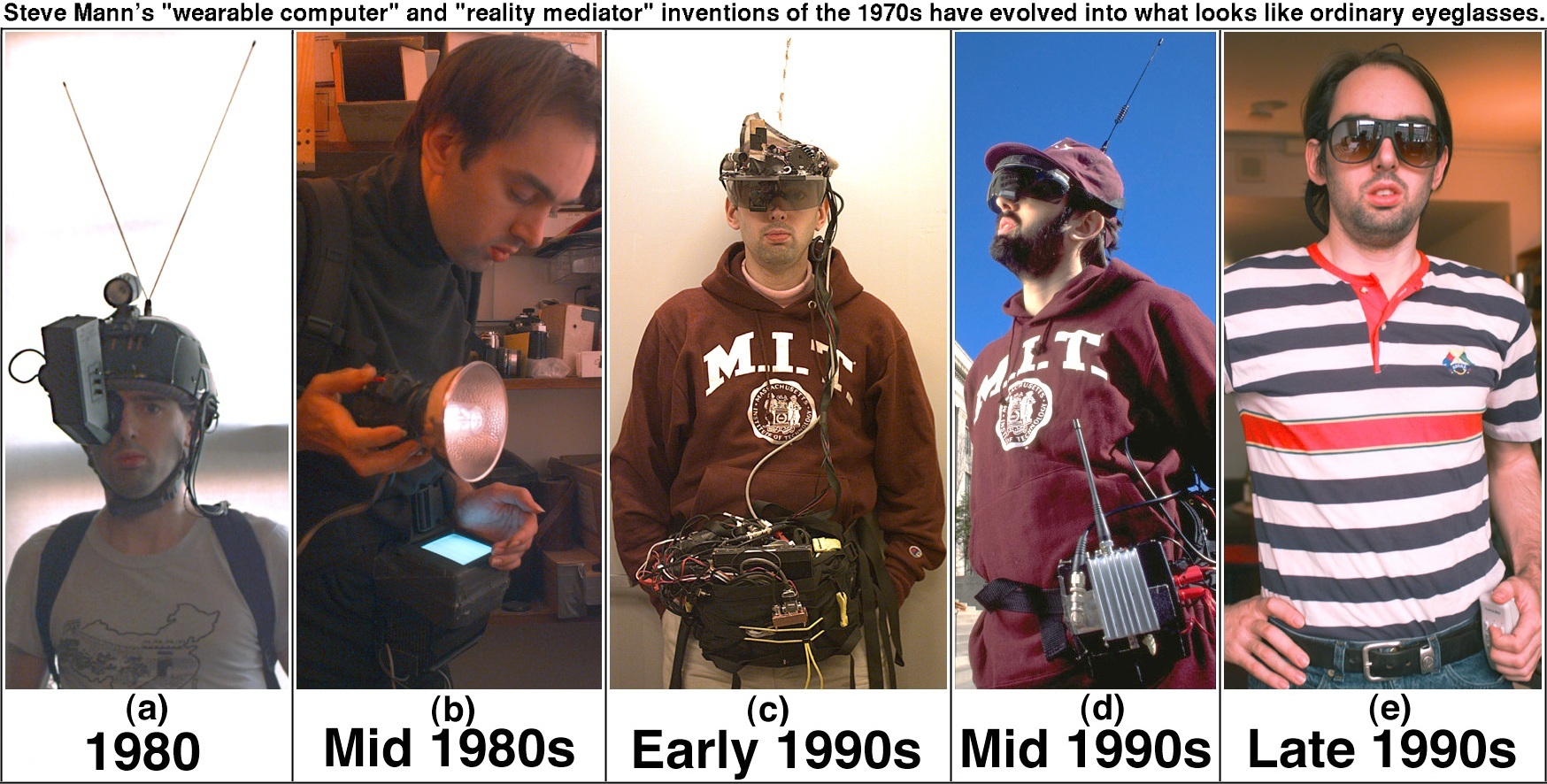
On page 126, artist Steve Mann presents his piece called WearComp, which shows his idea of a wearable computer. I think that this is already starting to become a reality as seen with something like google glass. I thinks it's impressive when an artists experiment with random custom made gadgets and innovates a potential gadget for the future. Something that Shanken mentions about Mann's piece really got me thinking. He he says that something like WearComp could help the blind (126). Now that is awesome, an artist that can help others while creating art at the same time is cool. Mann's intention was probably not to help the blind, but still, his experimentation as an artist can impact the life of others in a helpful way.
Shanken pg 96-120
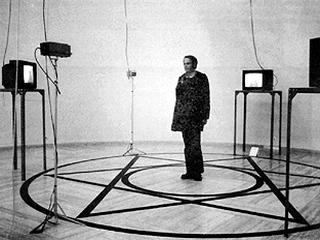
On page 106, a piece that caught my attention was Peter Weibek's piece called Obeservation of the Observation:Uncertainty, which had cameras positioned in a way that the viewer in the center could only see themselves from a third person perspective. Shanken writes that the piece "creat[ed] a shift of perceptual expectation that is very unsettling" (106). This is interesting because it changes the role of the person as no longer being a bystander viewing art, but instead the person becomes the art. I think that the reason why Shanken said it was "unsettling" was because it was changing the persons perception, which art normally doesn't do, unless it surreal art which I think does try to change the viewers perception. Also on page 106, the piece by Dan Graham called Present Continuous Pasts(s), was engaging because the viewer is watching themselves on video, but with a 8 seconds time delay. This piece is also similar to Weibek's piece because it changes the perception of the viewer and that they themselves are creating the art via the recorded video of themselves.
Subscribe to:
Posts (Atom)