My brother and I were tasked with utilizing an augmented reality app called aurasma and create the videos for it. At first I thought it was going to be easy, but it took quite a while to create the videos due to issues with the program After Effects. The newest version of After Effects on my PC no longer supported a file format known as flv. This was needed to create a video that had a transparent background utilizing the RGB+Alpha channel feature, which Adobe removed for the flv format. That was the biggest obstacle in my path. I spent three days researching how to get the video to have support for an RGB+Alpha channel in the flv format, but all I was able to produce was a 200mb avi file that did support the RGB+Alpha channel, but it was not supported with the augmented reality app. It was frustrating not getting it to work at home, but as soon as I checked on the PC's at school to see if the version of After Effects supported the flv format, and it turned out that it did! I was so relieved that it worked because it was essential for the project. All the struggles to get this working has made me an expert in making a video that has a transparent background. I wish Adobe had never removed the file format flv because people like me and others needing to create something similar will have a hard time doing it. The format flv is considered obsolete, but in my opinion, Adobe really shot themselves in the foot by doing this unnecessary removal of something helpful.
Here is the link to the game (if it doesn't work, the website people are still probably doing updates): http://www.perfectevil.com/
Thursday, December 10, 2015

English 402 Newsletter About Drones
For my English class I designed a newsletter that discussed my findings about peoples perceptions about drones. I created the survey a couple of days before Turkey Day and put it on the website fluidsurveys where I needed at least fifteen different responses. Once I got the responses I needed, I then compared the data to see if there was anything interesting. I found that a majority of people were comfortable with drones when they were used by the military, but not many were comfortable when they are being used domestically by companies like Amazon. Amazon is considering implementing their drones delivery system soon, and it's bothering many people. I use Amazon frequently to buy things that are not available in my small town of Othello, so something like drone delivery would come in handy for people in small towns like me. For those who don't shop online very frequently, something like drone delivery wouldn't be as helpful. The on;y problem I have with drones is that if they are being abused and being used for purposes that harm others, like acts of terrorism. I've seen a TV show called "Fugitivos de la Ley" which is spanish for fugitives of the law, and they were using a drone to observe a hostile gang related area and it worked out well. As long as drones are being used by responsible people, I wouldn't have a problem with them being used
Friday, December 4, 2015
TV show Project Greenlight
On my DVR I recorded an interesting show called Project Greenlight. It's a documentary about upcoming film directors that created short films, and the goal of the show was that one of these directors would be selected and then be funded by HBO to create a mini series. The ones that get to select the directors consists of talented producers, writer and even actors like Ben Affleck and Matt Damon. The winner was selected based on the short film they created, and so far the show is getting good. The winner had some interesting comments about how we wanted the series funded by HBO to be shot. He wanted it to be shot in film rather than digital, and insisted on it over it's better quality. But the producer working with him insisted that he was wrong and that digital filming is the way to go, and that shooting in film is a dying medium. I'm not sure if shooting in film is better than digital, but it's interesting to see that the winner doesn't want to back down from his decisions. I haven't finished the show yet, but watching it shows me just how much hard work gets put into the script, production, and post production. Filming a big movie is a team based effort, no one director can tackle such a huge project all by themselves and expect something great to happen.
Project 4 Dreamweaver
I am not the biggest fan of Dreamweaver, but it does taking a while to get used to. Last semester, I worked with Dreamweaver in one of Sena's class, which taught me a lot about the program. I watched a really helpful video on the Adobe website that discussed Dreamweaver and provided a tutorial. I followed along with the instructor on the video and created a professional looking website. I then used what I created from the tutorial as a template for my website. I will be tweaking the website for my project accordingly and my brother and I will be working on separate pages to provide the content. My brother created the poster, while I was working on the trailer for the film, just in case people wanted a sneak peek before they saw the full video. Overall it's coming along well, I downloaded Dreamweaver on my PC so that I can work on it at home. The semester is just about wrapping up, which is great, but I am going to miss working on creative projects since that's what I really enjoy doing. Who knows, maybe next semester will be filled with some more creative projects, I can't wait!
Reminiscing about The Watermelons
I still feel like the break was short, but I'm sure everybody does. The week of turkey day was quite relaxing, not doing much homework was refreshing. All my classes can sometimes be overwhelming, but when I look back at my Summer job at the watermelons, it put things back into perspective. I would rather be in my comfy room than in the scorching heat waking up at 4:30am to go to work for some many hours. One week at the watermelons we worked a total 80 hours! Talk about a big paycheck! But extremely exhausting mentally and physically. Starting at 5:30am and finishing at 9:00pm was the latest we got out at work, I will never forget that because the next day I still had to get up at 4:30am the next day! That didn't include the time to get home, shower, eat, and then finally sleep. I slept like a baby that day because all my body was drained of every calorie I had in me. My current workload is nothing compared to the watermelon days, even just thinking about it makes me want to write a blog post about it. I would rather read hundreds of books and do everyone's least favorite, blogs, than be at the watermelons. It's kind of a hate and love job, the pay is good, but there is a catch, lots of hours and being sore everyday with just one day off. It's like doing P90X on steroids, but at least I can say that I get paid to workout. Every time I see a watermelon, I say to myself,"A lot of hard work went into picking those babies, people better not be wasting watermelon."

Thursday, December 3, 2015
Internship
After searching, I finally found an internship that is going to be with Michael Mays, the director of the Hanford History Project. I was searching for an internship that utilized everything I learned from the various DTC courses I have taken. An internship that accepts multiple people was something I was looking for, because it would be convenient for my brother and I since we commute together. I would have wanted one in the Summer, but this one will be in the Spring. I wanted the internship to take the place of a Summer job, but I will be on the lookout for a paid internship to do in the Summer. Professor Doug Gast helped my brother and I find this internship and it's an internship that we are going to do together, which is extremely convenient for the both us. Also joining the team will be one of our classmates who was also looking for an internship, her name is Ryann. My brother and I are all set for next semester which will be 4 classes along with the internship. The internship will require us to work for about 9 hours a week, and on top that will be my other classes, I hope that I can manage to stay on top of things for next semester. I believe the internship won't be a paid one, but it's still required for my degree, but the main thing I want to get out of this is a lot of experience working in a potential real world situation with a possible future employer.
Tuesday, November 17, 2015
Narrative storytelling
Currently for my English 370 class we are reading one of Shakespeare's dramas called Hamlet. It's a great example of how to tell a narrative that has an introduction, rising action, climax, falling action, and conclusion. These are qualities of a narrative that my brother and I tried to follow and reading Hamlet gave my brother and I some ideas of how to put this kind of storytelling in action. There are multiple kinds of storytelling, but another type of storytelling that was present in some of my classmates projects was something called a non-linear narrative, which is also another way of storytelling. But with a linear narrative, a lot of planning will be involved, but there should always be some sort of planning even with something like a non-linear narrative. I think some people weren't sure of how to tell a narrative, but either way, I enjoyed the projects from my classmates. Something interesting that I remember from a popular film called The Matrix, directed by the Wachowski brothers, and there is a scene half way in the film where the main character Neo, awakens out the mainframe. That scene was shot last because it required him to have his head shaved, which obviously was planned ahead of time. This kind of planning is important in making a film. The scene needed to be shot at a specific time during the film making process and organized in post production to fit the narratives storyline properly and make sense.
Fine Art 435
For Dougs class, our entire class is working on a project that I can't wait to see completed. At the moment, it's still in it's production, but the project is going to be an augmented reality strategy game that is theme like a murder mystery, kinda of like what my brother did for our narrative for project 3. First, Doug broke us up into three groups to come up with potential project ideas. My group came up with an idea involving a murder mystery, another group came up with a river monster phenomenon, and thirdly there was an idea about a radiation experiment gone wrong at Hanford. We all voted for the one to officially do, and that was the idea about the murder mystery augmented reality app. Once we decided, we then divided up the workload about who would do what. Myself, and a few others, will be working on the audio portion. I think my experience with audio editing has greatly increased due to project 3 requiring quite a bit of it. The project is also a bit ambitious, but luckily we have the entire class working on it so that none of us will be overwhelmed with difficulty. It will be an augmented reality game using an application called Aurasma. It's still a work in progress, but it should be completed by December.
Thursday, November 5, 2015
Project 3 completion
This project has been my brother and I's most ambitious project yet. We will be completing our video on Final Cut Pro this morning, after staying all day Tuesday, Wednesday, and Thursday. This includes also staying all day on those same days for the past couple of weeks. This project is not something someone could do last minute. Someone could try to do projects like this last minute, but the quality of work will be obvious that not much effort was put into it. The workload was pretty consistent for my brother and I, we pretty much had our hands full managing the project and my other classes. It would be pretty difficult for someone to take on this kind of caliber of work by themselves. I'm pretty sure not many people would want to take on such an ambitious project, but my brother and I like to do something unique, and in spite of extreme difficulty, we persevere all the way to see the project completed. My brother and I, don't like to do something that was obviously procrastinated all the way, to barely meet the projects requirements. The goal for my brother and I, is to go above and beyond, which I think our project attempts to do. My only concern is that when its seems that others aren't working as hard as others (which I know I could be completely wrong about), get the same grade or higher, that kind of discourages me a little. But either way, I will know how much effort that was put in on our part to create a work that my brother and I are proud of in the end.
Monday, November 2, 2015
Project 3
I just completed editing all the voice acting using a program called Audacity. I have done audio editing before but not to this extent. It took a while to get up to this point in the project because a lot of pre-planning was needed. First my brother and I had to come up with a script which also took some time. Then we had to decide who the characters were and who was going to voicing them. That's where the fun part began. A small hobby that my brother and I have is that sometimes we voice act with my cousin, and we really get to just joke around and do impressions. Also, I have a good friend name John Go, who is an aspiring voice actor, and he really gave my brother and I some tips on how to record our voices. Once we had the voices from Myself, John, My cousin, and even John's girlfriend Katie, we were able to bring it together and create a story. That was only one side of the project, the other side was the video composing and editing, which my brother and I did together. This involved green screen, which is new to us, but we wanted to try something new. We have done stop motion before and we wanted to dive into unfamiliar waters. So far the video is almost completed, we just got to implement more camera angles and the finished voices which will make the piece function as a short film.

Shanken pg 256-290
On page 256, Shanken discusses artist Myron.W. Krueger and it's interesting to read what he has to say about man-machine interaction. Krueger does say something that got me thinking when he says, "Man -machine interaction is usually limited to a seated man poking at a machine with his fingers or perhaps waving a wand over a data tablet. Seven years ago, I was dissatisfied with a such a restricted dialogue and embarked on research exploring more interesting ways for men and machines to relate (256)." With the release of Windows 10, Microsoft introduced there new speech recognition interface called "Cortana", which allows a person to say what they want to search for instead of typing it using a keyboard/phone. The way that everyone interacts with machines is starting to change. For example, even Apple has there own version of Cortana called "Siri," which has also been quite popular among IPhone users for quite some time. This new type of interaction allows a person to feel like they are talking to someone who responds and assists them in a vocal/audible way.The machine may only do what it's being told, but a person is interacting with a machine, and this type of technology is bound to get better and better as the years go by. I personally still haven't caught on to this interaction using Cortana or Siri, but who knows, someday I will.

Sunday, October 25, 2015
Shanken pg 228-247
On page 245, Shanken discusses artists Steve Mann and it's a bit disturbing what he says,"Military computer vision systems are now turned back toward us where the hidden cameras in the public baths transform our world from Baywatch to Bathwatch. Hidden underwater cameras in municipal swimming baths (246)." I'm not sure on how accurate or widespread something like this is, but just thinking about it makes me think that anyone could be watching me. Just kidding, I'm not that paranoid. I'm glad I'm not that famous for someone to even want to spy on me and I wouldn't want that either. But this brings into question our privacy. How private are our lives in reality? Just because someone isn't recording you with a camera doesn't mean that they can't monitor you somehow. For example, anyone who has Internet can be monitored by the Internet Provider which does keep track of every website visited and what a person downloads. Most people are oblivious to the fact that they are in a sense being watched, but not directly but indirectly. It's not like the ISP is going to fine you for downloading illegal content which they could do by advising proper authorities. Either way, they're probably more concerned about how much bandwidth a person uses or as long as they pay their Internet bills on time.
Shanken pg 213-228
On page 217, Shanken discusses robotic architects like Nicholas Negroponte and what Negroponte says is interesting when he discusses machines, "However, it would appear foolish to suppose that, when machines know how to design, there will be no missing information or that a single designer can give the machine all that it needs. Consequently, we, at the Architecture Machine Group at M.I.T., are embarking on the construction of a machine that can work with missing information." It amazes me that people are working on something like this. This reminds me of a really advanced artificial intelligence machine that could possibly think on it own. I feel like there have been countless movies about something like this happening in films like Terminator and Marvels Avengers Age of Ultron. The kind of technology would hint that robots would be uncontrollable and disobey there commands. But those movies are works of fiction. This kind of technology seems like it could be used effectively to go to far away distances, but still, they would need a constant energy source to keep them running.
Wednesday, October 14, 2015
Shanken pg 202-213
On page 209, Shanken discuss artist Geoffrey Batchen and he says something that I would agree with when he says "In short, the absence of truth is an inescapable fact of photographic life." I think that most people would assume that they have the truth when they look at photographs from an article online or newspaper in front of them. Which one adequately portrays the truth of the photographs involved? Back then, before the digital age, most people though that the newspaper photographs in their hand was actually telling them the truth. And in the digital age, most people think that the photographs in the article online sometimes is trustworthy but not all the time. Why is there a trust in the newspaper over the online article? I would argue that both don't adequately ever told the truth. In some way, all images are manipulated whenever a newspaper or magazine is involved. That brings us to the concept known as "The Myth of Photographic Truth." Photographs or images that are taken, are then edited specifically to portray a "truth" and while ignoring other aspects that could have been photographed is a way of falsely trying to represent the truth. People nowadays wonder if photographs ever tell the viewer the truth because somehow they usually are tampered with i.e cropping, touch ups, etc.
Tuesday, October 13, 2015
Shanken pg 193-202
On page 198, Shanken introduces another artist who I have researched who's name is Nam June Paik. Shanken refers to something that I heard before in one of the fine arts courses I have taken with Doug when he says that "Marshal Mcluhan's famous phrase 'Media is the message' was formulated by Norbert Wiener in 1948 as 'The signal, where the message is sent, plays equally important role as the signal, where message is not sent' (198). This to me means that let says I made a video for an art class, the video's content is one thing, while the media being the video also sends a message that it's digital. At least that's what I remember it meaning. On page 194, Shanken discusses Lucio Fontana and he says something that I would say is a pretty bold statement, "We live in the mechanical age. Painted canvas and upright plaster no longer have a reason to exist." I would agree that we live in a mechanical age, but I would not agree with what he said about a painting canvas be obsolete. Artists like Bob Ross have been phenomenal at creating great paintings and I still see it as a vibrant and still living medium. The statement from Fontana really discredits the art making medium of painting, which I thinks can sometimes be more beautiful than something done mechanically.

Bob Ross
Shanken pg 182-193
On page 182, I think what Shanken says is pretty accurate when he says that "scientists increasingly have come to realize the value of artists not just as producers of attractive visualizations of data but as creative partners, whose insights and methods can fundamentally alter and expand their intellectual vision, spurring innovation and invention in the laboratory." I see artists, and this can come from practically any medium, as innovators because being recognized by scientists is a big step for the art making community to inspire artists to continue doing what they are doing, which is making art. This is something that I also interests me as an artist because as I view my classmates work, this makes me think that someday one of us DTC students will invent something innovative for the art world. On page 186, Shanken mentions artists who I have researched who's names are Steina and Woody Vasulka and there innovative institution called The Kitchen. Shanken describes it as ". . . the first American institutions to embrace the emergent fields of video and performance art, while also presenting new visionary work within the fields of dance, music, literature, and film (186). This institution helped launch the careers of artists and I think something like this is something that would greatly benefit all artists trying to make an name for themselves.

Sunday, October 4, 2015
Shanken pg 166-182
On page 166, Shanken discusses simulations and that "since the early 1970s, artists have further employed a variety of technologies and techniques to engage audience in increasingly interactive and immersive exchanges with simulated forms and environments." Simulations have so many different uses that it has been a frequently used medium by artists. Simulations are not just for artists, but have even by used by military and even for test flights for airplanes and such. One great example of simulations responding to a persons interaction is seen in a piece by Myron Krueger called Video Place. This is a way for the person to interact with a digital environment by using their own body to send signals from the camera to the computer and display it on video. This is something that video game console systems like the Xbox Kinect already utilize. Instead of a person using a controller to interact with the digital environment, a person can use their own body with the camera's recognition software so that the can play games with no strings attached. Artist like Krueger, probably inspired things like the Kinect, which is a good reason why artists should experimenting,even if people thing that what they are doing is weird or not even art.

Saturday, October 3, 2015
Shanken pg 140-166
On page 140, Shanken discuses that "Artists have joined their bodies, and their audiences, with electronic media or or created robots and other forms of surrogate beings in order to examine the cyborgian nature of human existence and to ponder what a post-human existence might be." This concept is intriguing because no one really knows what a future after humans would look like. I start to think of a film called I, Robot, and imagine it would look something like that but maybe not as chaotic. But at the moment, robots require someone to program them, they cannot function on their own without someone assisting in the maintenance of them. One piece in particular that has great potential is the piece called The Senster by Edward Ihnatowicz, which had many capabilities including being able to respond to stimuli via a microphone and computer. To me this feels like artists are trying create these robots to be somewhat alive, but once the artificial intelligence is implemented, that would be something awesome to see with all the other capabilities of these kinds of robots.

Friday, October 2, 2015
Shanken pg 120-140
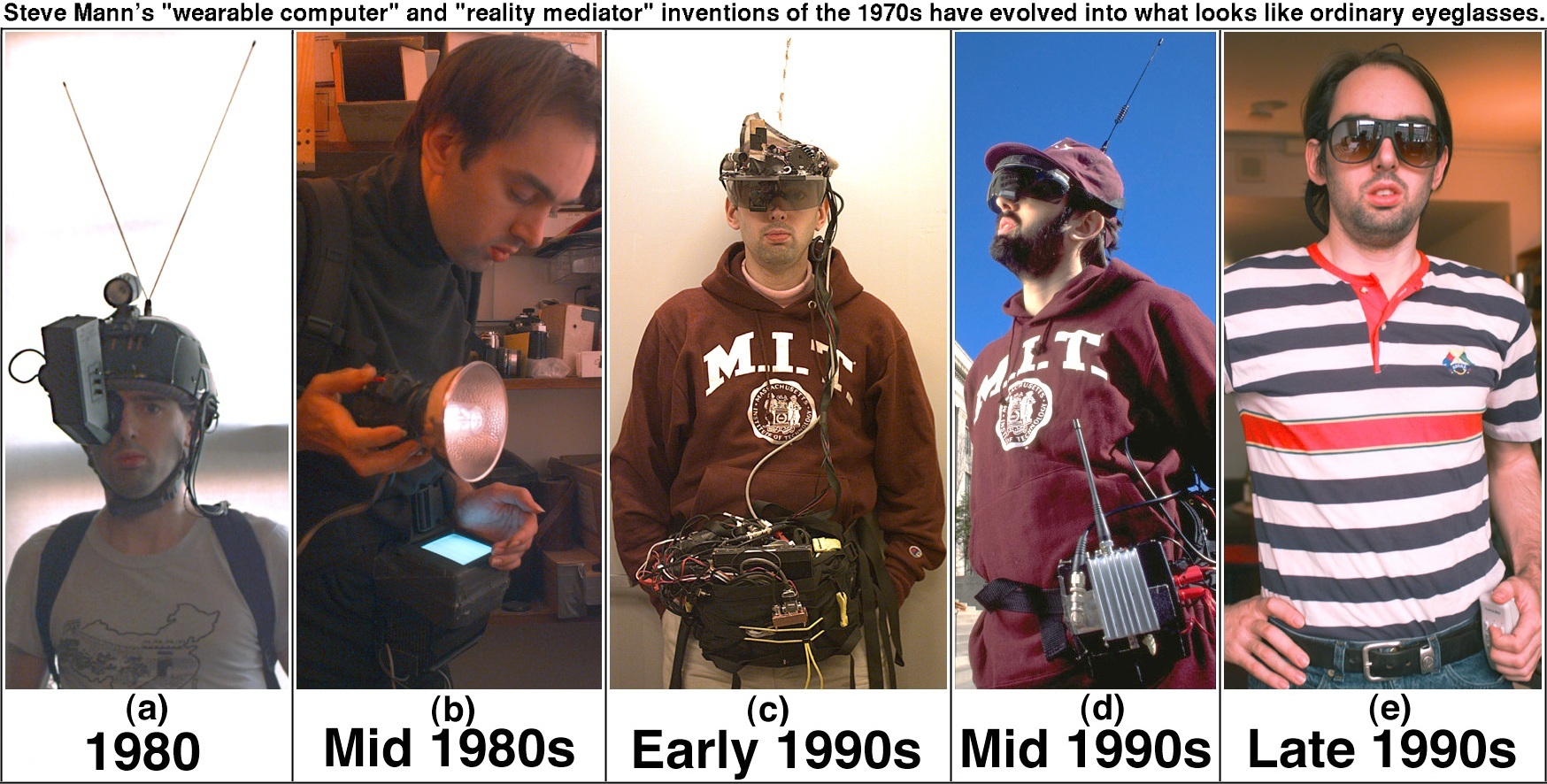
On page 126, artist Steve Mann presents his piece called WearComp, which shows his idea of a wearable computer. I think that this is already starting to become a reality as seen with something like google glass. I thinks it's impressive when an artists experiment with random custom made gadgets and innovates a potential gadget for the future. Something that Shanken mentions about Mann's piece really got me thinking. He he says that something like WearComp could help the blind (126). Now that is awesome, an artist that can help others while creating art at the same time is cool. Mann's intention was probably not to help the blind, but still, his experimentation as an artist can impact the life of others in a helpful way.
Shanken pg 96-120
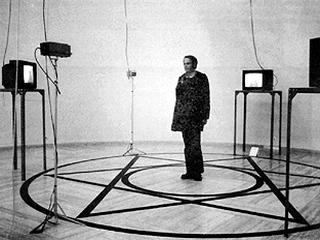
On page 106, a piece that caught my attention was Peter Weibek's piece called Obeservation of the Observation:Uncertainty, which had cameras positioned in a way that the viewer in the center could only see themselves from a third person perspective. Shanken writes that the piece "creat[ed] a shift of perceptual expectation that is very unsettling" (106). This is interesting because it changes the role of the person as no longer being a bystander viewing art, but instead the person becomes the art. I think that the reason why Shanken said it was "unsettling" was because it was changing the persons perception, which art normally doesn't do, unless it surreal art which I think does try to change the viewers perception. Also on page 106, the piece by Dan Graham called Present Continuous Pasts(s), was engaging because the viewer is watching themselves on video, but with a 8 seconds time delay. This piece is also similar to Weibek's piece because it changes the perception of the viewer and that they themselves are creating the art via the recorded video of themselves.
Sunday, September 20, 2015
Shanken pg 78-96
Shanken makes a statement that I would disagree with when he says that "...it has been argued that technologically reproduced art lacks the aura of an individually handcrafted original..." which he also finishes by saying that these types of works are "...demanding a reconsideration of the definition of art itself (78)." This is probably a good reason why people are afraid to step out of their comfort zone when they create art, they may be afraid that someone would call their work unoriginal or even that it is not even art. I would argue that technologically reproduced art is indeed art because I believe art can come from any medium and just because it's created by electronic means shouldn't disqualify it as even being called art. Shanken first presents computer art by Ben Laposky's piece called Oscillation #4, which is a unique looking abstraction that I would consider art. A lot of work goes on in electronically based art pieces, it's not just as if the art piece can just spontaneously create itself, there needs to be an artists who comes up with the idea and then begins to execute it any way possible. Many of the same principles for creating art do apply for electronically based art as well, the only difference is one is in a digital space while the other is defined in terms of the space around us.

Shanken pg 54-78
I really like the statement that Shanken makes when he says that artists were "defying the traditional conception of art" as they utilized motion in their work (54). This to me is intriguing because instead of staying in a comfort zone, artists sometimes step out of their comfort to create impressive pieces of art, and stepping out of my comfort zone is something that I am trying to do as I progress as an aspiring artist. A great example of this is seen in Laszlo Moholy-Nagy's piece called Light-Space Modulator, which was a piece that brought together light and movement and was featured in his film called Motion Picture Black-Whute Grey in the 1930 (54). Aided by engineers and technicians, Moholy-Nagy was able to create his work, and by presenting the piece in his film, allowed the work to get some exposure by a public audience. Also, Shanken says that "Such works laid a significant foundation for subsequent developments in interactive art...", which goes to show that by doing something innovative can really impact the art community and inspire established and even upcoming artist to create art by unconventional means, which I think is great and definitely is something to keep in mind (54).

Light-Space Modulatot by Laszlo Moholy-Nagy

Sunday, September 13, 2015
Shanken 45-54
On page 45, Shanken discuses the introduction of VR or "virtual reality" and that artists such as Jaron Lanier, developed the piece called The Sound of One Hand. It really impresses me whenever something is made that wasn't exactly intended to be used for art becomes it's another medium for an artist to expand their craft and try something new. When an artist steps out of their element and tries a different medium helps them become more versatile, which is a good thing. As VR technology gets better, things like (Cave Automatic Virtual Environment) or CAVE is basically a six sided room projecting a 3-D like environment and allows the person to be immersed in this virtual space, which is awesome. Shanken further discuses how art and technology are coming together when he says "the idea of joining art and technology seemed captivating", and he supports this by mentioning artists such as Cage, Rauschenberg and Paik (47). Art and technology joining together during the art creation process is something that I am very interested in and to create art with technology is fun.
Saturday, September 12, 2015
Shanken pg 30-45
On page 30, Shanken discusses the early interactive artists that created works that involved people as the software. This kind of interaction is seen in the piece by Les Levine called Contact: A Cybernetic Sculpture where people that walked by were turned in to software information that would be projected via video. I think this way of making art is very interesting because people unknowingly are involved in the art making process and as an artists, you may never really know what your going to get until you see the work. On page 31 Shanken discusses Kelly Heaton's piece called Reflection Loop, and that fact that it's a bunch of little Furby dolls that react to a person nearby is impressive, I had no idea something like this could be done with Furby technology. These kinds of participatory art pieces are interesting because instead of the art piece being a standalone piece, it now becomes this piece that involves people's interactions..
Saturday, September 5, 2015
Shanken pg 15-30
On page 16, Shanken discusses how the transition from static art to electronic media really made an impact on how we see art that is in motion. By using new techniques very similar to cinematography, artists were able to create art pieces that had movement. For example, Eadweard Muybridge's piece entitled Woman Walking Downstairs was a series of images that captured movement and probably was very innovative during his time (Shanken 16). It must of been surprising to see animation for the first time during the time when it was invented, and not only would it affect cinematography, but even the art world. The process of creating art is so flexible when it comes to utilizing new mediums because art can be made with pretty much any invention that may not have been intended to be used for art. One example that is seen is when artists utilized different light sources as Shanken mentions them using "...neon, fluorescent and laser[s]..." being used to create art (16).
Friday, September 4, 2015
Shanken pg 1-15
The brief introduction of how technology has improved in the U.S. was really helpful in understanding Shanken's point about artists and how they are looking at new ways of creating art (14-15). As I further improve my skills with digital art, I really look back and see how past artists used different mediums to create works of art. The pieces of art that I want to create this semester will reflect my current skill set and the knowledge and experience I have gained with computer programs. Shanken makes some great statements about the new technology influencing new artists to create new art pieces, which I think is a great thing because art has a powerful impact on shaping culture and values (16).
Subscribe to:
Posts (Atom)